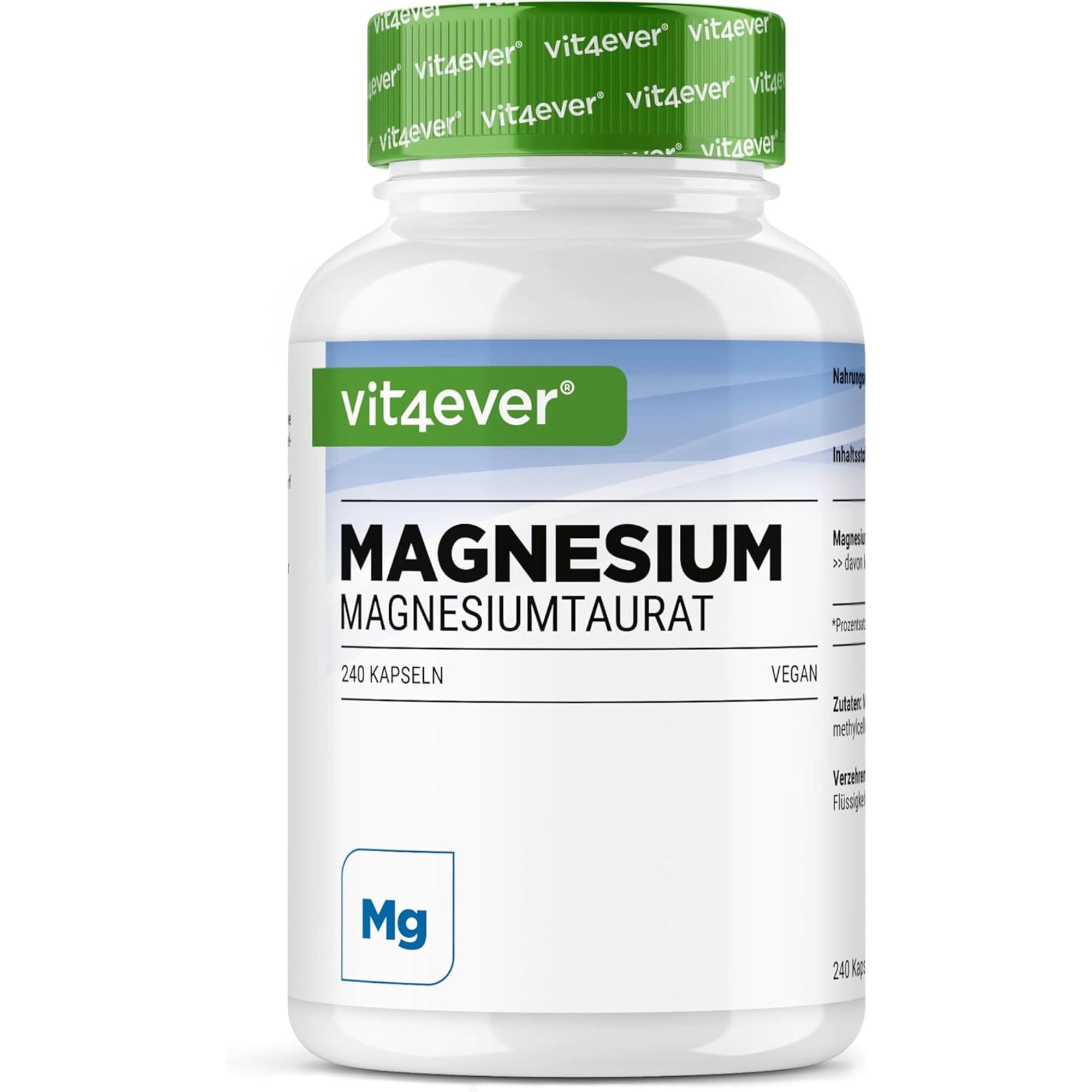
Vit4ever Magnesium Taurate 200mg
This Vit4ever magnesium taurate provides 200 mg of elemental magnesium per daily dose of three capsules, which is 53% of the reference intake. The special feature lies in the bond: here, magnesium is coupled with taurine, an amino acid-like substance naturally present in your body. This is a choice for those who deliberately opt for this specific form rather than a more common form like citrate or oxide, with 240 capsules in a jar that lasts for months.
Taurine, the amino acid to which magnesium is bound here
Taurine is often called an amino acid, although strictly speaking it is an aminosulfonic acid, a subtle nuance that, in practice, makes little difference to how you use the product. Your body produces it itself from the amino acids methionine and cysteine, and it is also naturally present in animal-derived foods such as fish and meat. In an exclusively plant-based diet, intake from food is generally lower, simply because the main natural sources are animal-based. In your body, taurine is mainly found in tissues that consume a lot of energy, such as muscle tissue, heart muscle, the brain, and the retina of the eye. There, it plays a role in regulating cell volume and forming bile salts, processes particularly relevant in tissues with high energy needs. In magnesium taurate, taurine is not added separately, but chemically coupled to magnesium in a single molecule. This is a different approach from a supplement where you would find magnesium and taurine side-by-side as two distinct substances in a capsule, which is common in some combination products.
Why this form is often chosen for the heart and muscles
Magnesium taurate regularly appears on the list of forms people consider when they are specifically thinking about heart or muscle tissue, and this is no coincidence: both magnesium and taurine are naturally present in relatively high concentrations in heart muscle and skeletal muscles. This is a factual observation about where these substances are found in the body, not a health claim about what the supplement would do for your heart. Manufacturers therefore choose this specific bond primarily because it corresponds to the tissue where both components are naturally present, not because the absorption per milligram would be higher than with other organic forms. It is, therefore, more a matter of logic in the composition than of a demonstrated additional effect: you combine two substances that the body already uses side-by-side in the same tissue anyway. If you want a form purely focused on the highest absorption per milligram, then bisglycinate or citrate are equally logical considerations.
Taurate compared to bisglycinate, citrate, and oxide
Magnesium never exists in a free state; it is always bound to another substance, and this bond determines both the absorption and the character of the supplement. Bisglycinate is coupled with the amino acid glycine, is known to be well absorbed, and is often felt to be gentle on the stomach, including by people who sometimes have an upset stomach with other forms. Citrate is bound to citric acid, is similar to bisglycinate in terms of absorption, and is one of the most commonly used forms in supplements, especially because the raw material is relatively widely available. Oxide is bound to oxygen, contains by far the most elemental magnesium per gram, but is less well absorbed per milligram than organic forms, which means that with oxide, a higher dosage per capsule is often seen. Taurate joins bisglycinate and citrate in terms of absorption, with the distinguishing factor being the taurine to which the magnesium is bound, something that none of the other forms offer. Since magnesium taurate itself contains only about 8% elemental magnesium, the daily dose of magnesium taurate is generous at 2550 mg, in order to still achieve a respectable 200 mg of elemental magnesium. The raw material used, according to the manufacturer, has a purity of 98%, meaning that the vast majority of each capsule is actually composed of the taurate compound.
For athletes and active individuals, and how to take it
Magnesium plays a role in many bodily processes, making it a mineral that active individuals and athletes like to keep at optimal levels. It contributes to normal muscle function and normal functioning of the nervous system, normal energy metabolism, and reducing fatigue. In addition, it contributes to normal psychological functions, normal electrolyte balance, normal protein synthesis, and the process of cell division, as well as maintaining normal bones and teeth. Especially during intense exertion or a demanding training schedule, the need for magnesium can increase, for example, due to sweat loss during exercise or because your muscles simply demand more from your mineral reserves on tough training days, something that can also be noticeable with a combination of strength training and endurance sports in the same week. For those who train regularly, a form that you can easily integrate into your daily life is therefore practical, without having to think about it. Distribute the three capsules throughout the day, for example, one at breakfast, one around lunch, and one in the evening, and take them each time with enough water. This way, you avoid taking everything at once and spread the absorption throughout the day. Some people prefer to take the last capsule in the evening, simply because this time fits most easily into their routine. Others simply combine it with their breakfast, lunch, and dinner, so that intake falls into a fixed rhythm by itself.
In short: a magnesium taurate with 200 mg of elemental magnesium per daily dose, bound to taurine, in 240 vegan capsules spread over three intake times. A targeted choice for those who deliberately opt for the taurate form rather than bisglycinate, citrate, or oxide, and see the combination with taurine as a plus.