
What is magnesium malate?
Magnesium malate is a combination of magnesium and malic acid (malate). Malic acid ensures relatively good solubility, which means that this form reacts differently in your digestion than, for example, magnesium oxide.
Warenkorb
Dein Warenkorb ist leer
Nicht auf Lager.
| Quantité | Prix unitaire | Remise |
|---|---|---|
| 1 pièce | €24,90 | - |
| 2 pièces | €23,66 | -5% |
| 3 pièces | €22,41 | -10% |
| 4 pièces | €21,17 | -15% |
Optionen wählen
| Quantité | Prix unitaire | Remise |
|---|---|---|
| 1 pièce | €24,90 | - |
| 2 pièces | €23,66 | -5% |
| 3 pièces | €22,41 | -10% |
| 4 pièces | €21,17 | -15% |
| Quantité | Prix unitaire | Remise |
|---|---|---|
| 1 pièce | €24,90 | - |
| 2 pièces | €23,66 | -5% |
| 3 pièces | €22,41 | -10% |
| 4 pièces | €21,17 | -15% |
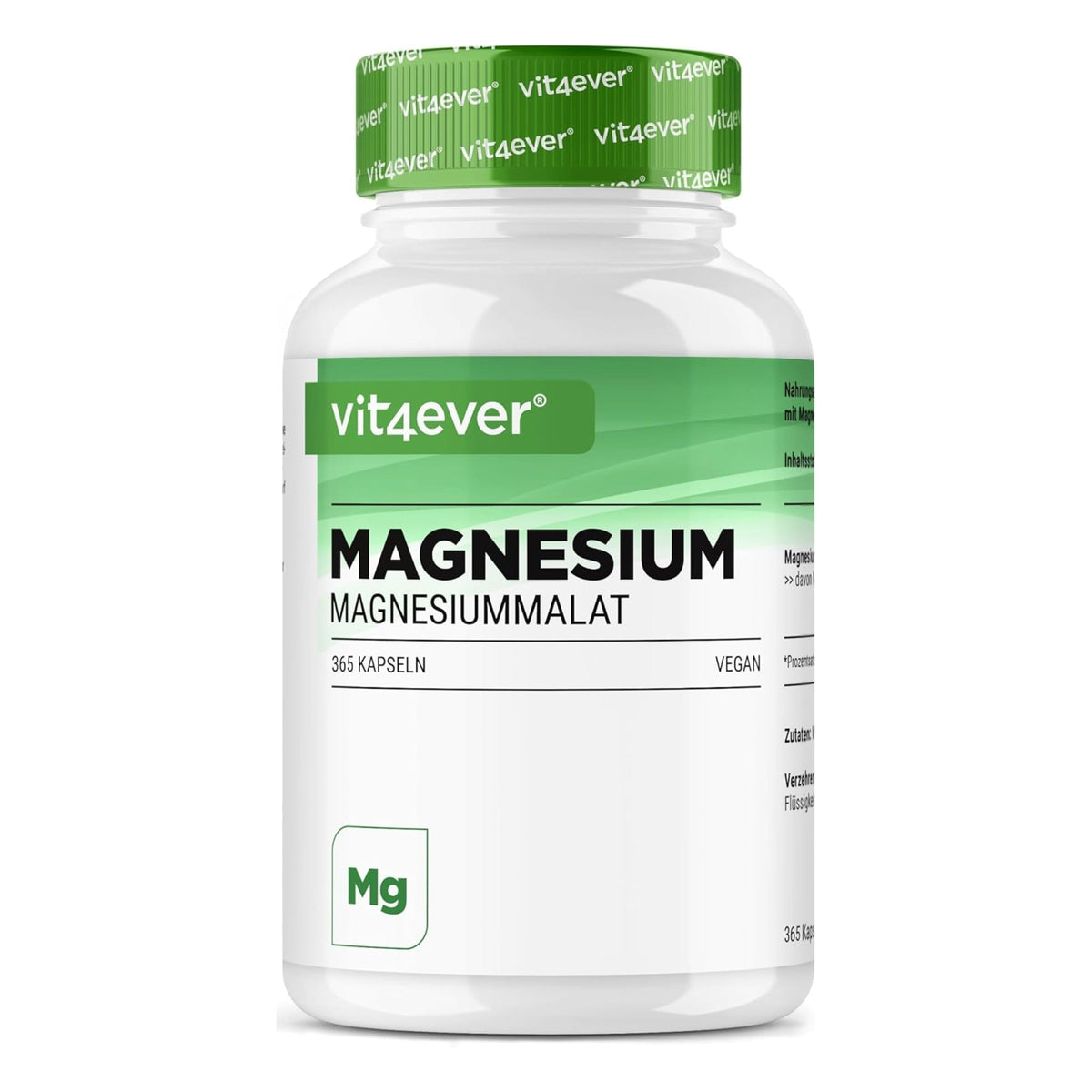
People who opt for magnesium malate in capsule form often do so for a simple reason: no tablet that first needs to disintegrate before your body can make use of it. Magnesium malate is a combination of magnesium and malic acid (malate), a substance that naturally plays a role in the citric acid cycle, the process by which your cells release energy from food. Vit4ever's magnesium malate comes in a vegetable cellulose (HPMC) capsule, without the binders and compressed powder that are pressed into a tablet. A daily serving of 3 capsules provides 300 mg of elemental magnesium, which is 80% of the reference intake.
Each jar contains 365 capsules, enough for over four months at the recommended dosage of 3 units per day. What many people don't realize is that with a tablet, your stomach first has to break down the compression force from the manufacturing process before absorption truly begins. A capsule simply dissolves as soon as the shell gets wet, without anything needing to disintegrate first.
The difference lies not in the active substance, but in the form surrounding it. A tablet is made by compressing powder under high pressure, often with binders like microcrystalline cellulose or additional stearic acid to ensure the tablet maintains its shape. With a capsule, this isn't necessary: the magnesium malate is loosely dosed into a shell, without any compression force. At Vit4ever, this shell is entirely plant-based (HPMC), making it suitable for those who prefer not to use gelatin. For people who have difficulty swallowing larger, harder tablets, a capsule is often more pleasant: the surface is smoother, the shape flexes slightly during swallowing, and there's no sharp edge like on an oval tablet. The swallowing process itself also works differently: a capsule slides down in one piece with a gulp of water, while a tablet sometimes sticks to the tongue or palate before descending.
In magnesium malate, magnesium is coupled with malate, the salt of malic acid. Malic acid is naturally present in apples and other fruits and is involved in the step of the citric acid cycle where cells produce usable energy from carbohydrates and fats. By binding magnesium to this specific molecule, a relatively water-soluble salt is obtained. This makes magnesium malate a different choice from, for example, magnesium oxide, a form that dissolves much less effectively and therefore reacts differently in your digestive tract. Vit4ever incorporates this form into a capsule so that you absorb the magnesium and malic acid all at once, without additional compression or tablet coating. Some tablets also receive a thin coating to mask the taste or strengthen the tablet; with a capsule, this coating is superfluous, as the shell itself is already taste-neutral.
A daily serving of 3 capsules provides a total of 2000 mg of magnesium malate, of which 300 mg is elemental magnesium: this is the part your body actually uses as magnesium. Broken down per unit, each capsule provides approximately 100 mg of elemental magnesium. Many wonder why manufacturers calculate with "elemental" magnesium rather than the total weight of the salt. In short: the salt (malate) does not count as magnesium; only the metal itself counts. 300 mg of elemental magnesium corresponds to 80% of the reference intake, an amount consistent with what is often used as a supplementary daily dose in nutritional research. Since the dose is distributed over 3 capsules, you can easily spread the intake throughout the day instead of taking everything at once.
Aside from magnesium malate, this capsule contains only the plant-based HPMC shell. There are no tablet binders, no glazing agents for a smooth coating, and no compressed powder—ingredients often found in compressed tablets to help the product retain its shape. This makes the ingredient list short and clear: magnesium malate and a capsule shell, nothing more. For those who always read the ingredient list of a supplement, this is a welcome point.
For those debating between a capsule and a tablet: the active substance, magnesium malate, is identical. Only the way you take it differs. A capsule is a practical choice if you prefer not to swallow a compressed tablet, if you have difficulty with larger tablets, or if you simply appreciate the shorter ingredient list inherent to capsules. And if you ever forget a capsule: do not take a double dose next time; simply resume your next daily serving as usual.
No gelatin or tablet binders, just a neutral vegetable shell around the magnesium malate.
A daily serving of 3 capsules provides 80% of the reference intake for magnesium.
Magnesium malate combines magnesium with malate (malic acid) in a readily soluble salt.
Over four months' supply at the recommended daily dosage of 3 capsules.
* Prozentsatz der Referenzaufnahme gemäß Verordnung (EU) Nr. 1169/2011.
Reply within one business day
Our customer service is available on weekdays from 9:00 AM to 5:00 PM.

Magnesium malate is a combination of magnesium and malic acid (malate). Malic acid ensures relatively good solubility, which means that this form reacts differently in your digestion than, for example, magnesium oxide.
A daily serving of 3 capsules provides 300 mg of elemental magnesium, which is 80% of the reference intake. This represents approximately 100 mg of magnesium per capsule.
Yes, the capsule shell is entirely plant-based and made from hydroxypropyl methylcellulose (HPMC), with no gelatin or other animal-derived binders.
Aside from the active substance, a capsule only contains its shell, without the binders and compressed powder necessary to give a tablet its shape. This makes the ingredient list shorter and swallowing easier for some users, as a capsule has a smooth surface and glides down effortlessly.
Malic acid is a substance that naturally plays a role in the citric acid cycle, the process by which cells release energy. Binding magnesium to malate results in a highly soluble salt, allowing you to combine magnesium and malic acid in a single capsule.
The active substance, magnesium malate, is identical in both versions. The difference lies in the form: the tablet version is compressed with tablet binders, while these capsules contain only a plant-based HPMC shell without compressed powder. The choice primarily depends on personal preference for swallowing.