LUTO Supplements Vin OPC pot de 90 capsules - extrait de pépins de raisin 95% PCO et 30% OPC | acheter en France
LUTO Vin OPC 100% vegan et hypoallergénique - extrait de pépins de raisin sans colorants
Pourquoi choisir LUTO Vin OPC - 333 mg d'extrait de pépins de raisin et 2 mois de réserve
LUTO Vin OPC 90 capsules - extrait de pépins de raisin à 95% PCO, dosage élevé, meilleure qualité

LUTO Supplements

Grape Seed OPC Extract (95% PCO - 30% OPC) | 90 Capsules | LUTO Supplements

Angebotspreis€14,90

Nicht auf Lager.

Tarifs dégressifs

Quantité Prix unitaire Remise
1 pièce €14,90 -
2 pièces €14,16 -5%
3 pièces €13,41 -10%
4 pièces €12,67 -15%

Spezifikationen

Kategorie Herbs & Plants
Artikelnummer luto-048
Barcode 8721055250449
Mindestens haltbar bis Auf Anfrage
Chargennummer Auf Anfrage
Inhalt 90 capsules
Anzahl Portionen 30

Grape Seed Extract OPC Capsules with 95% PCO

If you've ever looked into plant polyphenols, you've probably come across grape seed extract. It's rich in procyanidins, a group of substances naturally found in grape seeds. This LUTO Supplements product provides 166.7 mg of grape seed extract per capsule, standardized to 95% PCO and 30% OPC. These are not random abbreviations. They tell you exactly which part of the extract you're getting, and that's where the difference lies.

OPC stands for oligomeric proanthocyanidins. PCO stands for oligomeric procyanidins. It sounds complicated, but it boils down to this: grape seeds contain all sorts of polyphenols. Some are small molecules, others form long chains. The small, oligomeric variants, namely OPCs and PCOs, are processed differently by your body than the larger polymers. Smaller molecules cross the intestinal wall more easily. That's why standardization matters. A grape seed extract without specification can contain anything. With this product, you know that 95% of the extract consists of oligomeric procyanidins. That's a solid concentration.

The difference between 30% OPC and 95% PCO

Many people wonder why there are two percentages on the label. This is due to measurement methods. OPC and PCO partly overlap. They belong to the same family of grape seed polyphenols. The PCO percentage (95%) indicates the total fraction of oligomeric procyanidins. The OPC content (30%) is a more narrowly defined subset of this. In practice, this means you get a broad spectrum of oligomeric polyphenols, with a guaranteed portion of the smallest and most absorbable fractions. A grape seed extract without these specifications is often less transparent about its exact content.

Polyphenols and olive oil in the same capsule

What many people don't know: in addition to grape seed extract, this product also contains olive oil. Olive oil serves as a carrier here and is a natural addition to the formula. Combined with grape seed extract, you get a capsule that brings together two sources of plant polyphenols. The formula has otherwise remained intentionally simple: potato starch as an excipient and a gelatin capsule. No long list of additives.

Made in Germany under ISO certification

LUTO Supplements has this grape seed extract manufactured in Germany. Production is subject to DIN EN ISO 9001 and HACCP standards, two quality systems that guarantee control over purity and consistency. Every batch is tested. For a supplement where standardization is so crucial, this makes a difference. Claiming an OPC content of 30% is only valuable if you actually measure and control it. With 90 capsules per package, at two capsules a day, you have a 45-day supply.

In short: this is a concentrated grape seed extract that clearly states its contents. No vague percentages, no superfluous additives. Simply grape seed with a high oligomeric fraction, supplemented with olive oil. For those who consciously choose plant polyphenols as a daily supplement.

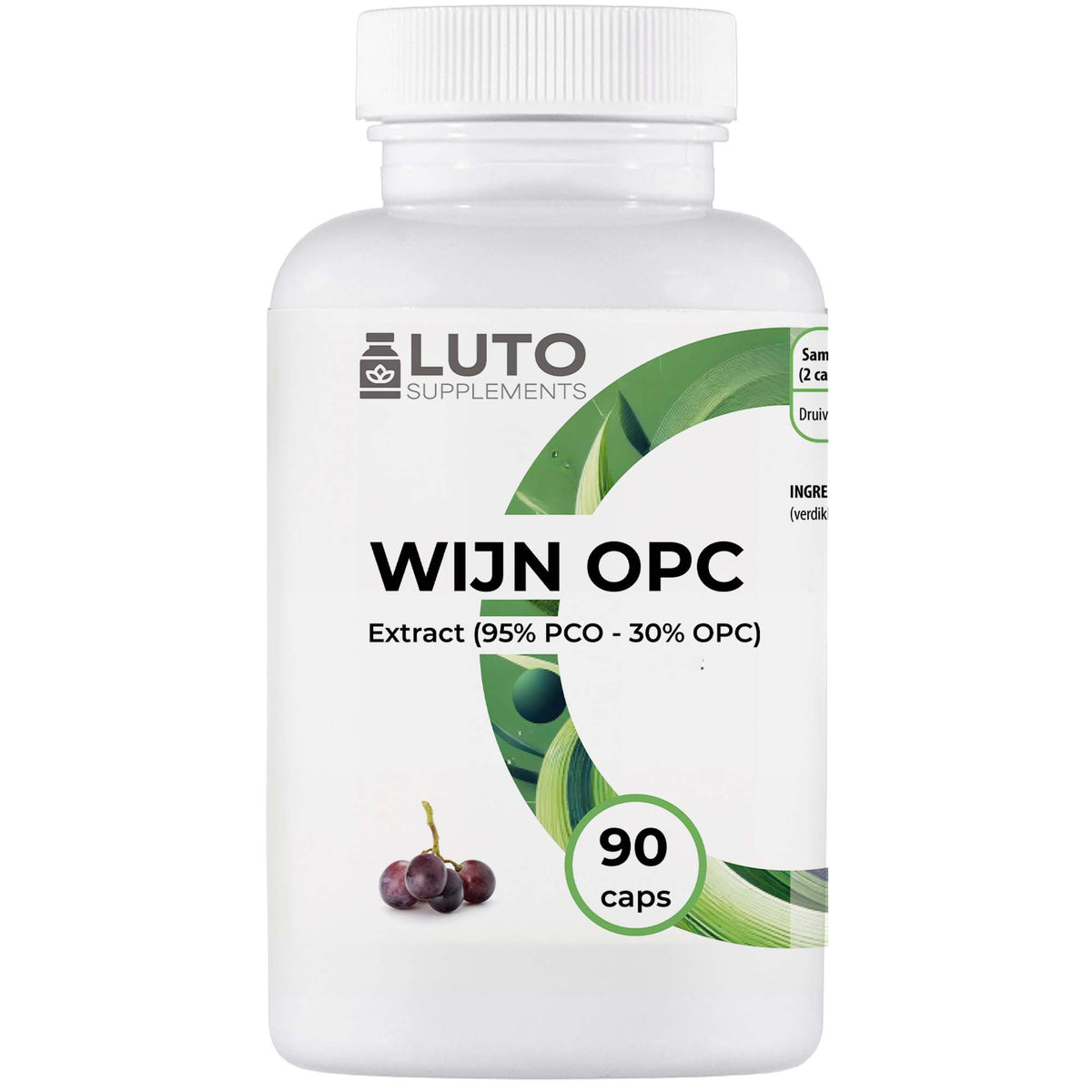
Why LUTO Supplements' Grape Seed Extract OPC (95% PCO - 30% OPC)?

95% Oligomeric Proanthocyanidins per capsule

The extract is standardised to 95% OPCs. This means that almost all of the extract consists of oligomeric proanthocyanidins, the smaller polyphenols that your body assimilates most easily. Many grape seed extracts do not indicate standardisation or are significantly lower.

333.4 mg of extract per daily dose

With two capsules, you get 333.4 mg of grape seed extract. This falls within the dosage range used in research on grape seed polyphenols (100-300 mg per capsule). This places you in the average range of what is common in clinical studies.

Grape Seed Extract combined with Olive Oil

In addition to grape seed extract, each capsule contains olive oil. It serves as a carrier, but at the same time contributes its own polyphenols. This way, you combine two plant-based sources of polyphenols in a single capsule, without any additional additives.

Made in Germany under ISO 9001 and HACCP

Production takes place in Germany under DIN EN ISO 9001 and HACCP certification. Each batch is tested for purity. For a product where standardization is so critical to quality, this control makes a concrete difference.

Zusammensetzung

* Prozentsatz der Referenzaufnahme gemäß Verordnung (EU) Nr. 1169/2011.

Ingredients:
Grape seed extract (95% PCO - 30% OPC), potato starch, gelatin (capsule shell, thickener), olive oil.
Instructions for use:
Take 2 to 3 capsules daily with sufficient water, preferably during a meal. Follow the recommended dosage or the advice of a specialist.
Storage advice:
Store in a dry place, away from light and out of reach of children.
Safety:
Food supplements do not replace a varied and balanced diet or a healthy lifestyle. Do not exceed the recommended daily dose. Keep out of reach of children. If you are taking anticoagulants, antiplatelet agents, or other medications, consult your doctor or pharmacist first. Also exercise caution if you are pregnant, breastfeeding, or anticipating surgery, as safety data for these situations is limited.

Health claims

  • Polyphenols in olive oil: contribute to the protection of blood lipids from oxidative stress.

Any questions?

Reply within one business day

Our customer service is available on weekdays from 9:00 AM to 5:00 PM.

  • 💬 Cat
  • 📧 customerservice@luto-supplements.nl
  • 📞 038 - 303 2160
Referente

Frequently Asked Questions

What exactly is grape seed extract?

Grape seed extract is a concentrated extract derived from grape seeds (Vitis vinifera). These seeds are rich in polyphenols, a large group of plant substances. Through extraction and standardization, the concentration of specific polyphenols, such as procyanidins, is increased compared to what you would get from eating grapes. The higher the standardization, the more precisely you know what each capsule contains.

What do OPC and PCO mean on the label?

OPC stands for Oligomeric Proanthocyanidins, and PCO stands for Oligomeric Procyanidins. Both terms refer to small chains of polyphenols from grape seeds. They largely overlap but are determined by different measurement methods. The 95% PCO content indicates the total oligomeric fraction, while the 30% OPC content is a more narrowly defined part of it. Together, they tell you that this extract is highly concentrated in smaller, more absorbable polyphenols.

Can you use grape seed extract every day?

Yes, grape seed extract is intended for daily use. When taken regularly, side effects are usually mild, such as slight stomach upset. Take the capsules with a meal, which is gentler on your stomach. If you are taking anticoagulants or other medications, consult your doctor first.

90 capsules, isn't that a small amount for the price?

At the recommended dose of 2-3 capsules per day, you have a 30-45 day supply. This is comparable to most grape seed extracts on the market. The difference lies in the standardization: 95% PCO is a solid concentration. Here, you are paying for an extract with transparent content, not a large bottle with uncertain content.

Why are oligomeric procyanidins better absorbed than other polyphenols?

Polyphenols come in different sizes. Some form long molecular chains (polymers), while others are short (oligomers). The short oligomer variants cross the intestinal wall more easily because their molecular size is smaller. Larger polymers are largely unabsorbed and leave your body unused. This is why it is important that this extract is standardized for the oligomeric fraction rather than the total polyphenol content.

What is the difference between grape seed extract and resveratrol?

Both come from grapes but from different parts. Resveratrol is primarily found in the skin and is isolated as a single polyphenol. Grape seed extract comes from the seeds and contains a broad spectrum of procyanidins, which are chains of multiple linked polyphenols. Thus, they are related but different substances with distinct polyphenol profiles. The choice depends on what you are looking for: a single substance or a broader spectrum from the grape seed.