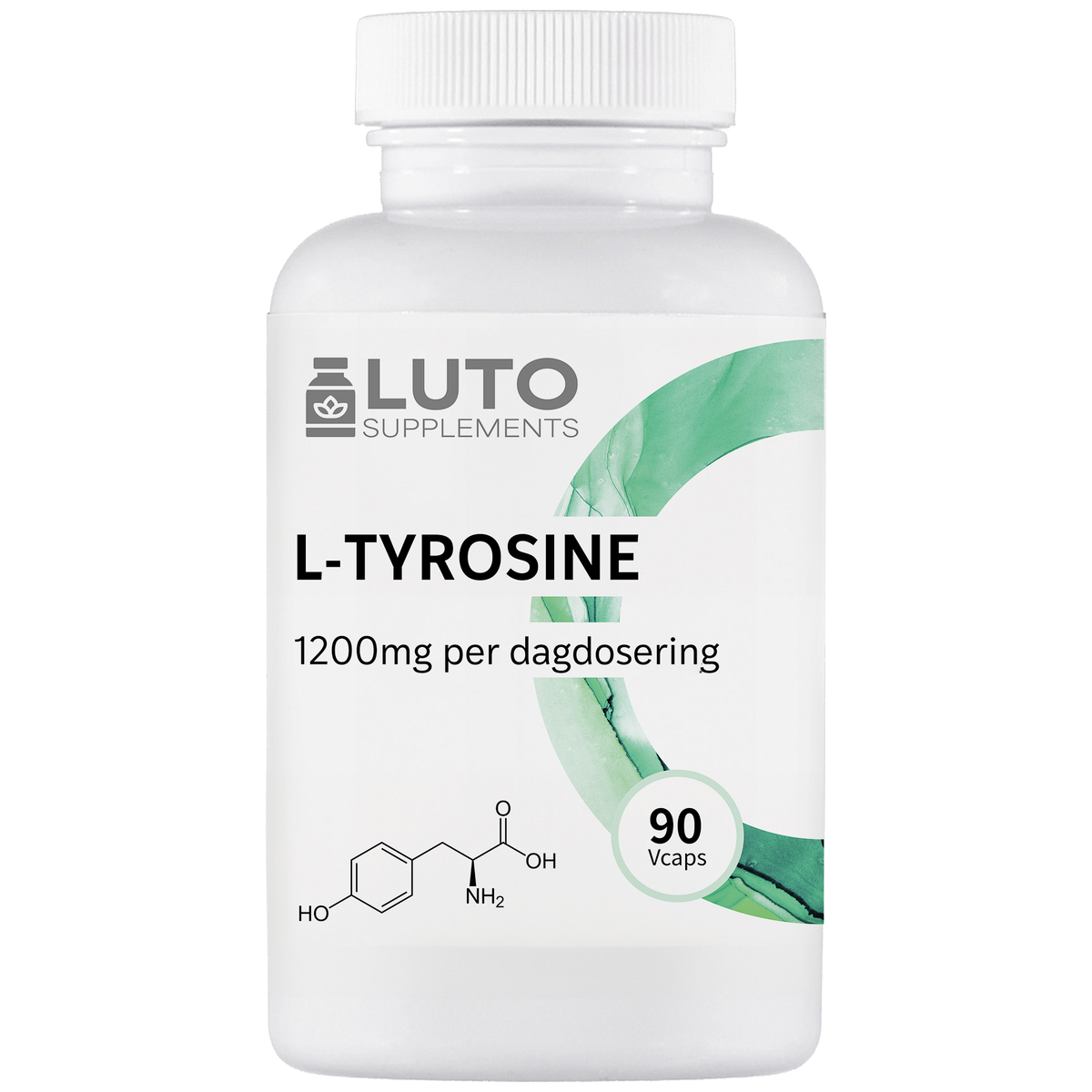
LUTO Supplements L-Tyrosine 1200mg 90 gélules avec biotine et vitamine B | acheter en France
LUTO L-Tyrosine 1200mg comparaison, 90 gélules avec biotine, vegan, sans gluten et testé en laboratoire
Qualité premium gélules LUTO L-Tyrosine, vegan, sans gluten, sans colorants ni arômes artificiels
Ingrédients purs L-Tyrosine LUTO Supplements, 1200mg de L-Tyrosine par dose journalière avec vitamine B
LUTO L-Tyrosine 1200mg pour la santé cognitive et la concentration, gélules d'acide aminé végétal

LUTO Supplements

L-Tyrosine with Biotin 1200mg | 90 Capsules | LUTO Supplements

Angebotspreis€20,90

Nicht auf Lager.

Tarifs dégressifs

Quantité Prix unitaire Remise
1 pièce €20,90 -
2 pièces €19,86 -5%
3 pièces €18,81 -10%
4 pièces €17,77 -15%

Spezifikationen

Kategorie Amino acids
Artikelnummer luto-001
Barcode 8720865080826
Mindestens haltbar bis Auf Anfrage
Chargennummer Auf Anfrage
Inhalt 90 capsules
Anzahl Portionen 45

L-Tyrosine 1200 mg with Biotin Capsules

Do you know that feeling of having your head too full? Busy workweeks, too many tabs open, and in between, you're still trying to think clearly. During such times, many people look for ways to supplement their amino acid intake. L-Tyrosine is one such amino acid. This supplement from LUTO Supplements provides 1200 mg per daily dose, spread across two vegetable capsules. And it contains biotin (vitamin B8). A remarkable addition that you won't find in all tyrosine supplements.

What L-Tyrosine does exactly in your body

L-Tyrosine is an amino acid that your body normally produces itself from phenylalanine, another amino acid from your diet. Think of chicken, eggs, dairy products, or nuts. In your cells, L-Tyrosine serves as a raw material. Your body converts it step by step: first into L-DOPA, then into dopamine, and finally into noradrenaline and adrenaline. These are signaling substances that are involved throughout your brain. The difference with tyrosine from a steak? In capsules, it's in free form. Not bound to proteins, so your body doesn't need to break it down first. What many people don't know: the absorption of L-Tyrosine competes at the blood-brain barrier (the gate between your blood and your brain) with other large amino acids. If you take it with a protein-rich meal, more amino acids are queuing up. That's why taking it on an empty stomach or between meals is often more favorable.

Why biotin is included in this formula

In addition to the amino acid, each daily dose contains 50 µg of biotin. That's exactly 100% of the reference intake. Most L-Tyrosine capsules on the market contain only the amino acid itself. Here, this vitamin is added as standard. Biotin contributes to normal energy-yielding metabolism and normal macronutrient metabolism. But it doesn't stop there. Biotin also contributes to the normal functioning of the nervous system and normal psychological function. The combination is logical: L-Tyrosine provides the raw material, while biotin plays a role in your energy metabolism and nervous system.

Where 1200 mg of L-tyrosine per day falls within the dosage range

Per capsule, there is 600 mg of L-Tyrosine. With two capsules a day, you reach 1200 mg in total. In practice, this means you are at the higher end of what is common for amino acid supplements in this category. In scientific research, higher amounts are sometimes used, around 100 to 150 mg per kilogram of body weight. For a 75-kilogram person, that quickly amounts to 7500 mg or more. That's a different story altogether. But for daily use as a supplement, 1200 mg is a solid dosage. A jar contains 90 capsules, so at the recommended intake, you have enough for 45 days.

Free L-Tyrosine versus the acetyl variant

There are several forms of this amino acid on the market. The two most well-known are regular L-Tyrosine and N-acetyl-L-tyrosine (NALT). The difference lies in absorption. Regular L-Tyrosine is the most studied and common supplement form. NALT seems interesting on paper, but in practice, this variant turns out to be less well-supported when it comes to increasing the level of free tyrosine in your blood. LUTO Supplements has chosen the classic free form here. The capsules themselves are made of HPMC, a vegetable cellulose base. No gelatin, no animal ingredients. The product is also gluten-free and lactose-free, and it is manufactured in the Netherlands.

In short: a straightforward amino acid supplement with a thoughtful addition of biotin. Vegetable capsules, produced domestically, and with the most common form of L-Tyrosine. For anyone who wants to supplement their daily intake during busy periods, without superfluous additions.

Why L-Tyrosine with Biotin 1200mg from LUTO Supplements?

Free L-Tyrosine, the most studied form

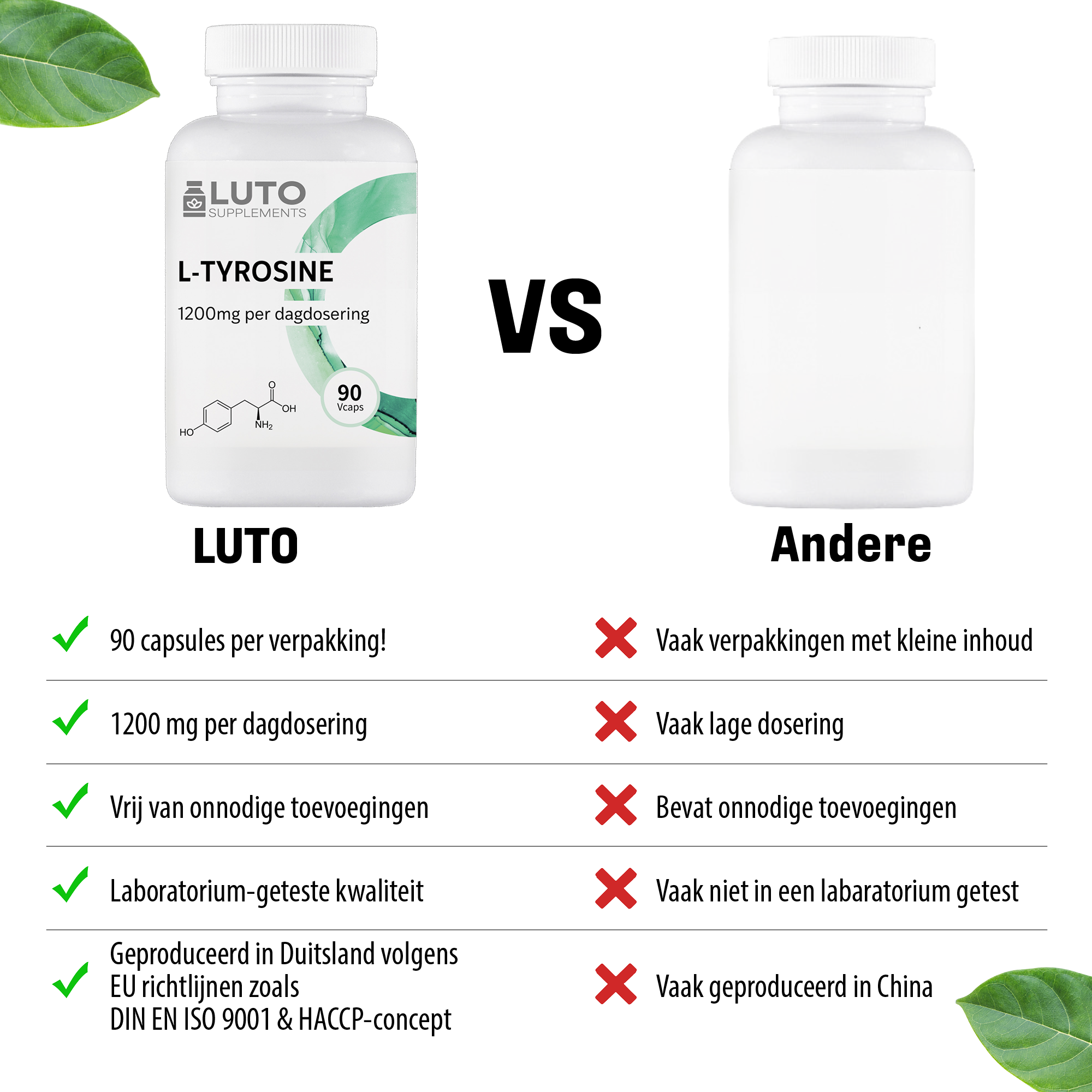
This product contains plain free L-Tyrosine, not the acetyl variant (NALT). Free L-Tyrosine is the most studied supplement form and increases tyrosine levels in your blood more effectively than NALT. Your body does not first need to cleave the amino acid from proteins, so it is directly available.

1200 mg per daily dose in two capsules

Two capsules together provide 1200 mg of L-Tyrosine. This places you at the higher end of what is common for amino acid supplements in this category. The dosage is divided into two capsules of 600 mg each, so you can easily spread them throughout the day.

Biotin as a standard addition to the formula

Most L-Tyrosine capsules on the market contain only the amino acid. Here, 50 µg of biotin (vitamin B8) are added as standard, which is exactly 100% of the reference intake. Biotin contributes to the normal functioning of the nervous system and to normal energy metabolism.

Vegetable Capsules, Made in the Netherlands

The capsules are made from HPMC, a plant-based cellulose. No gelatin or animal ingredients. The product is gluten-free and lactose-free and is made in the Netherlands.

Zusammensetzung

* Prozentsatz der Referenzaufnahme gemäß Verordnung (EU) Nr. 1169/2011.

Ingredients:
L-Tyrosine, capsule shell: hydroxypropyl methylcellulose (HPMC), anti-caking agents: silicon dioxide (E551) and fatty acids with calcium, bulking agent: microcrystalline cellulose (E460), D-Biotin (vitamin B8).
Directions for Use:
Take 2 capsules daily with sufficient water, preferably spread throughout the day. Take the capsules away from a protein-rich meal for better absorption.
Storage advice:
Store at room temperature in a dry place and out of reach of young children.
Safety:
Food supplements are not a substitute for a varied and balanced diet or a healthy lifestyle. Do not exceed the recommended daily dose of 2 capsules. Keep out of reach of young children. If you are pregnant, breastfeeding, taking medication, or have a medical condition, always consult your doctor or pharmacist before using this supplement. Exercise particular caution if using levodopa, MAO inhibitors, or thyroid medications, as L-Tyrosine is involved in the production of catecholamines and thyroid hormones. Biotin may affect laboratory results, particularly in immunoassays such as thyroid values and troponin. Always inform your doctor if you are taking biotin when undergoing blood tests.

Health claims

  • Biotin: Biotin contributes to normal energy-yielding metabolism
  • Biotin: Biotin contributes to the maintenance of normal hair
  • Biotin: Biotin contributes to the maintenance of normal skin
  • Biotin: Biotin contributes to normal macronutrient metabolism
  • Biotin: Biotin contributes to normal psychological function
  • Biotin: Biotin contributes to the maintenance of normal mucous membranes
  • Biotin: Biotin contributes to the normal functioning of the nervous system

Any questions?

Reply within one business day

Our customer service is available on weekdays from 9:00 AM to 5:00 PM.

  • 💬 Cat
  • 📧 customerservice@luto-supplements.nl
  • 📞 038 - 303 2160
Referente

Frequently Asked Questions

What exactly is L-Tyrosine?

L-Tyrosine is an amino acid that your body normally produces itself from phenylalanine, another amino acid from your diet. In your cells, it serves as a raw material for signaling substances like dopamine, norepinephrine, and adrenaline. It is naturally present in protein-rich foods such as chicken, eggs, dairy products, and nuts. In supplement form, it is present as a free amino acid, meaning it is not bound to proteins. Therefore, your body does not need to break it down first.

When is the best time to take L-Tyrosine?

Preferably not with a protein-rich meal. The absorption of L-Tyrosine into your brain competes with other large amino acids at the blood-brain barrier. If you take it with a lot of protein, more amino acids will be vying for absorption. On an empty stomach or between meals, absorption is more favorable.

Is L-Tyrosine suitable for daily use?

Yes, at the dosage of this product (1200 mg per day), it is in line with common supplement practice for daily use. In scientific research, much higher dosages are sometimes used, but these are for specific acute situations. Please adhere to the recommended dosage and consult your doctor if in doubt.

1200 mg per day, isn't that too little compared to research dosages?

Indeed, in studies on acute cognitive load, higher dosages are used, often around 100 to 150 mg per kilogram of body weight. For a person weighing 75 kilograms, this quickly amounts to 7500 mg or more. This is a different type of use. For daily supplementation of your tyrosine intake, 1200 mg is at the higher end of what is common for amino acid supplements in this category. It is therefore a solid maintenance dosage, not an acute research dosage.

How does L-Tyrosine work in your body?

L-Tyrosine serves as a direct raw material for a chain of signaling substances. The enzyme tyrosine hydroxylase first converts it into L-DOPA. Then, this is converted into dopamine, and then into noradrenaline and adrenaline. These are neurotransmitters that are involved throughout your brain. Tyrosine is also a component of thyroid hormones T3 and T4. In its free form, such as in capsules, your body does not need to break it down from proteins first, which makes it more quickly available.

What is the difference between L-Tyrosine and N-Acetyl-L-Tyrosine (NALT)?

The difference lies in absorption and scientific backing. Regular L-Tyrosine is the most studied supplement form and effectively increases free tyrosine levels in your blood. N-Acetyl-L-Tyrosine looks interesting on paper due to the acetyl group, but in practice, this variant has less scientific support when it comes to actually increasing these levels. This product contains the free form, which is the common choice for this type of supplement.