LUTO Supplements Glucosamine pot de 90 gélules - 1500 mg de glucosamine par dose journalière
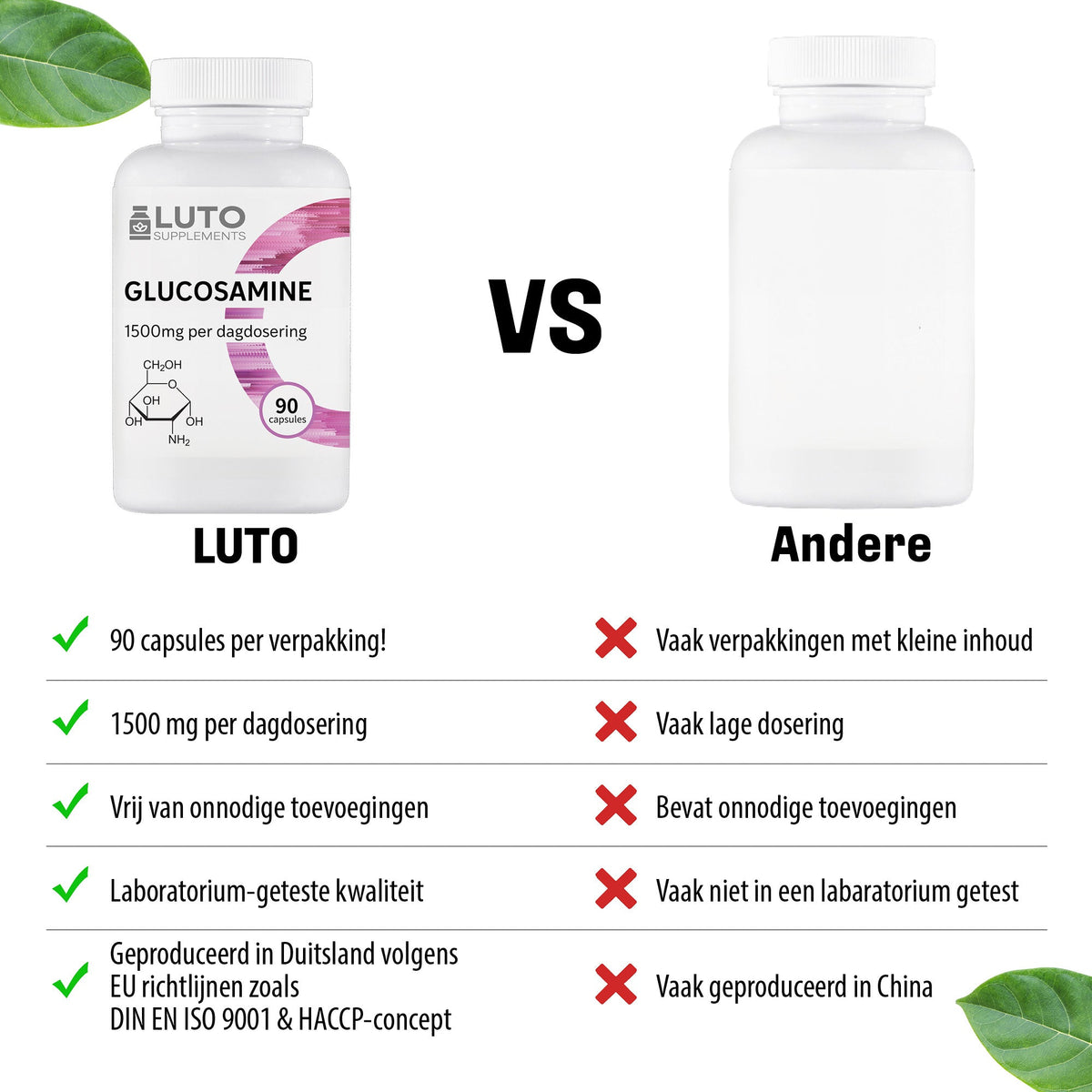
Comparaison LUTO Glucosamine avec d'autres marques - 1500 mg par dose journalière, testée en laboratoire
LUTO Glucosamine qualité premium - formule complète avec manganèse, sans colorants
Composition des gélules LUTO Glucosamine - avec silicium de bambou, manganèse, vitamines D et K1
LUTO Glucosamine pour les articulations - 1500 mg de glucosamine avec manganèse

LUTO Supplements

Glucosamine 1500 mg | 90 capsules | LUTO Supplements

Angebotspreis€17,90

Nicht auf Lager.

Tarifs dégressifs

Quantité Prix unitaire Remise
1 pièce €17,90 -
2 pièces €17,01 -5%
3 pièces €16,11 -10%
4 pièces €15,22 -15%

Spezifikationen

Kategorie Other
Artikelnummer Auf Anfrage
Barcode 8721055250463
Mindestens haltbar bis Auf Anfrage
Chargennummer Auf Anfrage
Inhalt Auf Anfrage
Anzahl Portionen Auf Anfrage

Highly Dosed Glucosamine 1500 mg Capsules

Are you looking for a glucosamine formula that goes beyond just glucosamine? This LUTO Supplements product provides 1500 mg of glucosamine sulfate 2KCl per daily dose (3 capsules), enriched with MSM, bamboo silica, devil's claw, pine bark extract, and a range of vitamins and minerals. Three capsules a day is all it takes. The jar contains 90 capsules, enough for one month.

What Glucosamine Sulfate 2KCl Really Is

Glucosamine is an amino sugar naturally present in your cartilage and connective tissue. Your body produces it itself, but production decreases with age. In supplement form, it is most often extracted from the chitin of crustaceans. The "2KCl" in glucosamine sulfate 2KCl refers to potassium chloride, a salt that stabilizes the molecule. This sounds technical, but it means that glucosamine keeps well in this form and provides a consistent amount of active substance. At 1500 mg per daily dose, this product is precisely at the dose most often used in scientific research. This is no coincidence: this amount has served as a reference dose for glucosamine supplements for years.

The Role of Vitamin C with D3 and K1 in This Formula

What many don't know: this formula also contains 90 mg of vitamin C, 7.5 µg of vitamin D3, and 252 µg of vitamin K1. These are not random additions. Vitamin C contributes to normal collagen formation for the normal function of cartilage. Collagen is the protein that gives structure to your joints, tendons, and skin. Without enough vitamin C, this collagen formation is less effective. Vitamin D3 contributes to the maintenance of normal bones, as does vitamin K1. Together, they form a trio that complements a formula focused on the musculoskeletal system. Vitamin C also helps protect cells from oxidative stress, which is relevant for tissue under daily stress.

MSM with Bamboo Silica and the Rest of the Profile

In addition to glucosamine sulfate 2KCl, each capsule contains 99 mg of MSM (methylsulfonylmethane), an organic sulfur compound. Sulfur is a building block for the body's connective tissue structures. Honestly, 99 mg is a low value compared to what is used in research, where doses of 1500 to 4000 mg are common. However, MSM still provides an additional sulfur component here alongside the sulfate group of glucosamine itself. Bamboo silica extract (105 mg, standardized to 75% silicon) is a plant-based source of silicon. The formula also contains 99 mg of devil's claw and 100 mg of pine bark extract. This combination makes it broader than a standard glucosamine capsule.

Why the Sulfate Form Matters

There are different forms of glucosamine. The two best known are glucosamine sulfate and glucosamine hydrochloride. The difference lies in the sulfate component. Sulfate plays its own role: it is involved in the sulfation of cartilage components. In short, glucosamine sulfate 2KCl provides not only glucosamine itself but also the sulfur building blocks your cartilage needs. This is why this form appears more often in clinical research than the hydrochloride variant. LUTO Supplements has opted for this stabilized sulfate form, and it is a deliberate choice.

Why LUTO Supplements' Glucosamine 1500 mg?

1500 mg of glucosamine sulfate per capsule

This product provides precisely the daily dose most often used in clinical research. One capsule per day, with no fractional dosing required.

Sulfate form with additional sulfur building blocks

Glucosamine sulfate 2KCl not only provides glucosamine, but also sulfate. This sulfate component is involved in the sulfation of cartilage constituents. The hydrochloride variant lacks this. This is why glucosamine sulfate is the form with the strongest research base for joint applications.

Vitamins C, D3 and K1 for cartilage and bones

Vitamin C contributes to normal collagen formation for the normal function of cartilage. Vitamins D3 and K1 contribute to the maintenance of normal bones. Three vitamins that logically complement a joint formula, all in a single capsule.

A Complete Profile Rather Than Just Glucosamine

In addition to glucosamine, each capsule contains MSM, bamboo silica, devil's claw, pine bark extract, manganese, and copper. Most glucosamine capsules on the market contain only glucosamine or glucosamine with chondroitin. This formula covers more building blocks in a single daily dose.

Zusammensetzung

* Prozentsatz der Referenzaufnahme gemäß Verordnung (EU) Nr. 1169/2011.

Ingredients:
Glucosamine sulfate 2KCl (from shellfish), gelatin (capsule shell), bamboo silica extract (75% silicon), pine bark extract (95%), devil's claw, methylsulfonylmethane (MSM), vitamin C (ascorbic acid), vitamin K1 (phytomenadione), vitamin D3 (cholecalciferol), manganese citrate, copper citrate, magnesium stearate (vegetable anti-caking agent).
Directions for use:
Take 3 capsules daily with water, preferably spread throughout the day and with a meal. Do not take on an empty stomach.
Storage advice:
Store in a dry place, away from light and out of reach of children.
Safety:
This product contains glucosamine from shellfish. Do not use if you are allergic to shellfish. Food supplements are not a substitute for a varied and balanced diet and a healthy lifestyle. Do not exceed the recommended daily dose. If you are pregnant, breastfeeding, taking medication (especially anticoagulants such as warfarin), or have a medical condition, always consult your doctor or pharmacist before using a supplement. In cases of diabetes, increased blood sugar monitoring is recommended. Keep out of reach of children.

Health claims

  • Vitamin C: Vitamin C contributes to normal collagen formation for the normal function of cartilage
  • Vitamin C: Vitamin C contributes to normal collagen formation for the normal function of bones
  • Vitamin C: Vitamin C contributes to normal collagen formation for the normal function of skin
  • Vitamin C: Vitamin C contributes to normal collagen formation for the normal function of blood vessels
  • Vitamin C: Vitamin C contributes to normal collagen formation for the normal function of teeth
  • Vitamin C: Vitamin C contributes to normal collagen formation for the normal function of gums
  • Vitamin C: Vitamin C contributes to normal energy-yielding metabolism
  • Vitamin C: Vitamin C increases iron absorption
  • Vitamin C: Vitamin C contributes to maintaining the normal function of the immune system during and after intense physical exercise
  • Vitamin C: Vitamin C contributes to the normal function of the immune system
  • Vitamin C: Vitamin C contributes to the protection of cells from oxidative stress
  • Vitamin C: Vitamin C contributes to normal psychological functions
  • Vitamin C: Vitamin C contributes to the regeneration of the reduced form of vitamin E
  • Vitamin C: Vitamin C contributes to the reduction of tiredness and fatigue
  • Vitamin C: Vitamin C contributes to the normal functioning of the nervous system
  • Vitamin D: Vitamin D contributes to normal blood calcium levels
  • Vitamin D: Vitamin D contributes to the maintenance of normal bones
  • Vitamin D: Vitamin D contributes to the normal absorption/utilisation of calcium and phosphorus
  • Vitamin D: Vitamin D has a role in the process of cell division
  • Vitamin D: Vitamin D contributes to the normal function of the immune system
  • Vitamin D: Vitamin D contributes to the maintenance of normal teeth
  • Vitamin D: Vitamin D contributes to the maintenance of normal muscle function
  • Vitamin K: Vitamin K contributes to normal blood clotting
  • Vitamin K: Vitamin K contributes to the maintenance of normal bones

Any questions?

Reply within one business day

Our customer service is available on weekdays from 9:00 AM to 5:00 PM.

  • 💬 Cat
  • 📧 customerservice@luto-supplements.nl
  • 📞 038 - 303 2160
Referente

Frequently Asked Questions

What exactly is glucosamine sulfate 2KCl?

Glucosamine is an amino sugar naturally present in your cartilage and connective tissue. The "2KCl" designation means that the molecule is stabilized with potassium chloride, a salt that makes glucosamine preservable and consistent. In practice, this means that after consumption you simply absorb free glucosamine, but the raw material in the capsule is more stable than unstabilized forms.

What is the difference between glucosamine sulfate and glucosamine hydrochloride?

The difference lies in the sulfate group. Glucosamine sulfate provides, in addition to glucosamine, sulfate, which is involved in the sulfation of cartilage components. Glucosamine hydrochloride does not contain this sulfate component. In clinical research, glucosamine sulfate is the most frequently and most favorably studied form for joint applications. This is why many joint formulas, including this one, opt for the sulfate form.

Why are vitamins C, D3, and K1 also included in a glucosamine formula?

Vitamin C contributes to normal collagen formation for the normal function of cartilage. Collagen is the structural protein of your joints, tendons, and skin. Both vitamins D3 and K1 contribute to the maintenance of normal bones. Together, these three vitamins therefore cover both cartilage and bone, which logically aligns with a formula focused on the musculoskeletal system.

99 mg of MSM, isn't that very little compared to stand-alone MSM supplements?

Yes, that's correct. Research uses daily doses of 1500 to 4000 mg of MSM, so 99 mg is significantly lower. The MSM in this formula is therefore not a substitute for a stand-alone MSM supplement. It is rather an additional sulfur component alongside the sulfate group already present in glucosamine itself. If you desire a therapeutic dose of MSM, you might consider taking a separate MSM product as a supplement.

How Does Glucosamine Work in Cartilage?

Glucosamine serves as a building block for glycosaminoglycans and proteoglycans. These are structural components of the cartilage matrix, the tissue that lines your joints. Glucosamine can also inhibit processes that drive cartilage degradation, such as certain inflammatory signals. The sulfate component further provides the sulfur necessary for the sulfation of these same cartilage constituents. In short, glucosamine sulfate provides both the building blocks and the "glue" for the cartilage matrix.

What's the difference between a standalone glucosamine capsule and this combined formula?

A standard glucosamine capsule only contains glucosamine, sometimes with a filler. This formula adds MSM, bamboo silica, devil's claw, pine bark extract, and vitamins (C, D3, K1), plus the trace elements manganese and copper. The advantage is that a single capsule provides a broader profile. The disadvantage is that some additions, such as MSM at 99 mg, are dosed lower than if you took them separately.